Evidence tiers: [Verified] = backed by official documentation or reliable primary sources; [Community Consensus] = widely shared user experience not formally confirmed by the vendor; [Unverified / Speculative] = hypothesis or not yet independently verified—treat with caution.
Important Notice (Please Read First)
- Cross-border network routing is subject to local laws and telecommunications regulations in each jurisdiction (for example, international internet gateway regulations in Mainland China). Always apply the concepts in this article strictly within compliant and lawful boundaries.
- This guide explains technical concepts and operational risks only; it does not provide setup tutorials for proxies or VPNs, instructions for bypassing regional restrictions, or vendor recommendations.
- Spoofing your location to circumvent a vendor's regional eligibility rules typically violates the vendor's Terms of Service and can result in permanent account suspension without appeal.
1. Four Networking Terms That Are Often Confused
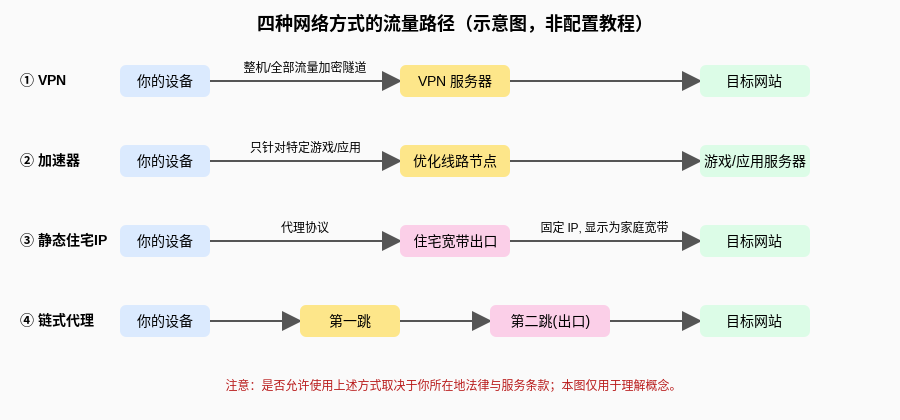
| Concept | One-Line Definition | Typical Legitimate Use Case | Egress IP Characteristics |
|---|---|---|---|
| VPN | Establishes an encrypted tunnel between your device and a remote server, typically routing whole-device traffic | Corporate remote access to internal networks; protecting privacy on public Wi-Fi | Usually a data-center (hosting) IP shared among multiple users |
| Traffic Accelerator | Optimizes routing paths for specific games or applications to reduce latency | Multiplayer gaming, application-specific latency reduction | Route-dependent; not designed for general web browsing |
| Static Residential IP | A fixed egress IP address allocated to a consumer broadband ISP | Cross-border e-commerce storefront management, regional ad verification (commercial operations) | Fixed address registered under a residential ISP |
| Chained Proxy | Routes traffic sequentially through multiple proxy hops, using the final hop as the egress node | Separating transit link stability from the final egress IP identity | Determined by the final hop in the chain |
[Verified (General Networking Fundamentals)] For background on how VPNs and proxies differ, see: Cloudflare Learning Center: What is a VPN? and What is a proxy server?
1.1 Why IP Address Classification Matters to Risk Systems [Community Consensus]
Automated risk-control systems routinely classify connecting IP addresses by ASN and usage profile:
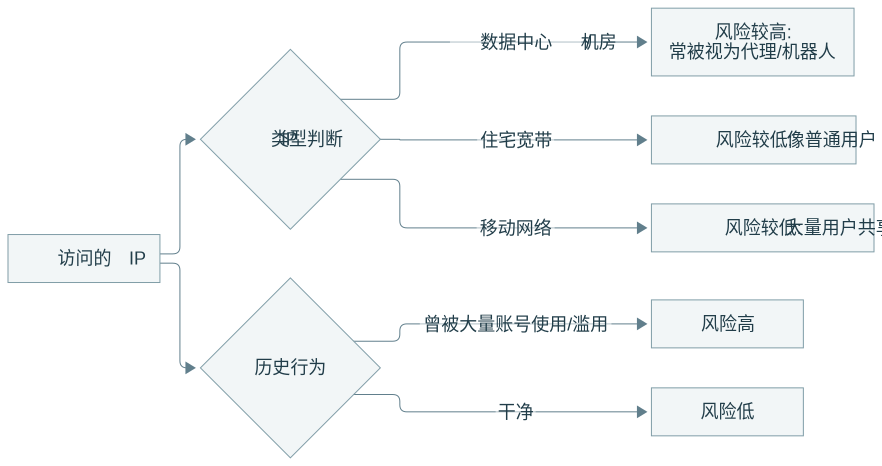
- This is why online discussions often mention "static residential IPs": fixed + residential ISP resembles a regular home internet subscriber in one location.
- [Community Consensus] However, IP classification is only one signal among many. Platforms also evaluate account registration details, payment card issuing country, phone number prefix, browser/device fingerprints, timezone and locale settings, and usage patterns. A clean IP address alone does not guarantee account safety.
1.2 The Two-Stage Logic of Chained Proxies [Community Consensus]
- The first hop handles transit quality (bandwidth and latency), while the final hop determines the egress identity (IP classification and country/region).
- Trade-off: every additional hop introduces another third party capable of observing traffic metadata, increases round-trip latency, and makes connection failures harder to debug.
2. Account Risk Controls: Evaluating Claude Account Suspension Risks
2.1 Verified Facts [Verified]
- Anthropic offers Claude.ai and commercial API access strictly within its published list of supported countries and territories: https://www.anthropic.com/supported-countries; for API regional availability, see https://platform.claude.com/docs/en/api/supported-regions
- Anthropic's Terms of Service and Acceptable Use Policy: https://www.anthropic.com/legal/consumer-terms, https://www.anthropic.com/legal/aup
2.2 Author's Assessment [Unverified / Speculative]
Editorial assessment: Even when users connect from what appears to be a "clean" network setup, Claude accounts accessed from unsupported regions still face a relatively high risk of suspension, likely because:
- Risk evaluation spans far more than IP reputation (billing instrument, phone verification country, device environment, and behavioral signals all factor in);
- Community reports of sudden account bans without detailed explanations have persisted over time [Community Consensus];
- Appeal success rates reported by affected community members remain low [Community Consensus].
Note that these observations reflect community reports rather than official statistics, as Anthropic does not disclose its internal risk-scoring rules.
Most reliable recommendation: If your jurisdiction is not on a vendor's supported list, prioritize models and tools that officially operate in your region; never anchor critical production workflows on an account that could be terminated at any moment.
3. Google Antigravity Regional Eligibility: Governed by Google Account Country Association
3.1 What Official Documentation States [Verified]
Source: Antigravity FAQ
- Antigravity is currently open only to personal Google accounts associated with an approved country/region; users experiencing issues with Google Workspace accounts are advised to test with a standard
@gmail.comaccount. - Official guidance: Check the country/region displayed on your Google Terms of Service page; if the listed country is inaccurate, you can submit a request to update your country association.
- Unavailable to users under 18; age verification is required.
- The approved regions list does not include Mainland China or Hong Kong (you can inspect the full list in the official FAQ; Taiwan and other jurisdictions are listed).
3.2 Egress IP Location vs. Google Account Country Association
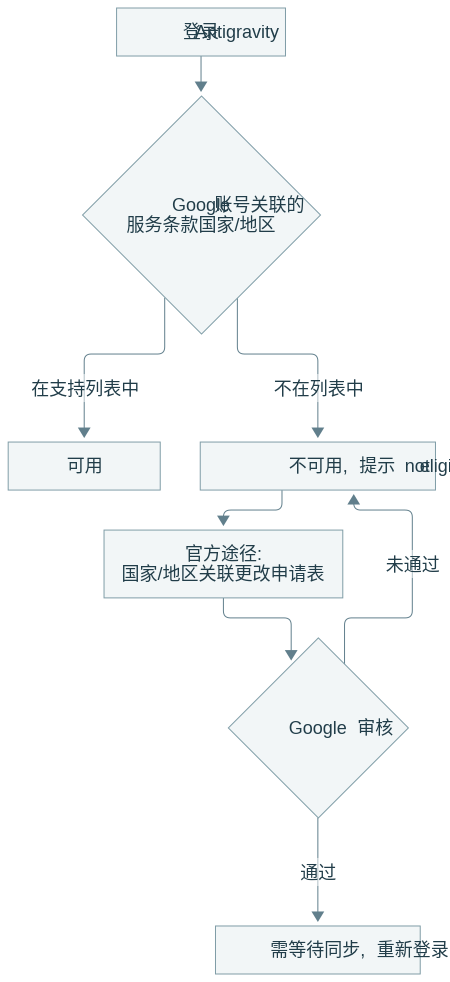
- [Verified] A Google account's Terms of Service country association can be updated via Google's official form: https://policies.google.com/country-association-form. Google notes that this form is intended for cases where the recorded country does not match where you actually reside, is subject to manual or automated review, is not guaranteed to be approved, and takes time to propagate. See Google Privacy & Terms FAQ.
- [Verified (Developer Forum Report)] Users on the Google AI Developer Forum have reported cases where an account remained flagged as location-ineligible even after a country association update: Forum Thread.
- [Community Consensus] In practice, eligibility checks primarily inspect the Google account's associated country rather than just the current session's IP address—though that does not mean IP location is ignored entirely, and Google does not publish its internal eligibility logic. [Unverified]
- ⚠️ Compliance reminder: The country association form exists to reflect your true country of residence. Submitting false residency details to gain access to a region-restricted service may violate Google's Terms of Service. Additionally, the official FAQ explicitly states that accessing Antigravity via third-party tools or automating account rotation violates its terms or is unsupported (see magpie, New API, and Cockpit Tools: How the Three Categories Differ).
4. VPS, Domains, and Static Sites: The Three Pillars of Web Deployment
This section has nothing to do with cross-border proxy routing—it covers the core web publishing fundamentals that anyone shipping an AI project or documentation site to the web needs to know.
4.1 The Three Core Components
| Component | Analogy | What It Is | Typical Use Cases |
|---|---|---|---|
| VPS (Virtual Private Server) | Renting an apartment | A virtual Linux/Windows machine slice from a cloud provider with a dedicated public IP running 24/7 | Hosting backend APIs, self-hosting New API (magpie, New API, and Cockpit Tools), running background agents |
| Domain Name | Street address / door number | A human-memorable name like example.com that resolves to an IP address via DNS |
Giving users a stable address to reach your site |
| Static Website | A printed poster in a shop window | Pre-built HTML/CSS/JS/image files that require no server-side runtime database or backend code | Personal sites, documentation portals, portfolios, tutorial collections |
Note: Questions asking about "static web addresses" are addressed here primarily in the sense of static websites; if you meant a fixed IP address or domain mapping, refer to Section 1 (Static Residential IP) and the DNS overview below. [Unverified: terminology note]
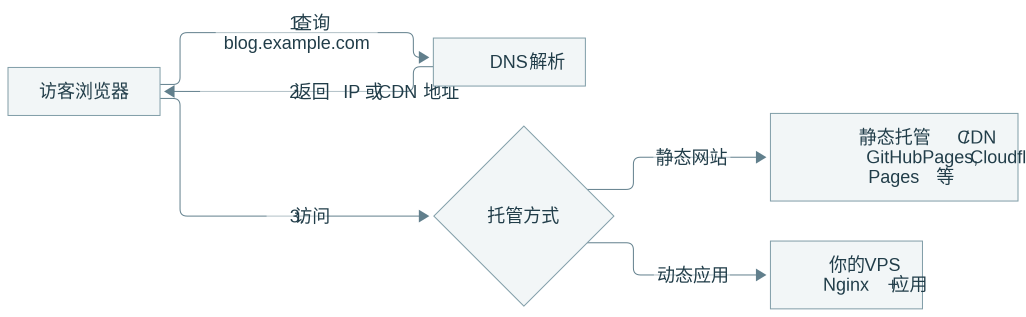
4.2 Static Websites: Shipping Without Managing a Server [Verified]
- GitHub Pages: https://docs.github.com/en/pages
- Cloudflare Pages: https://developers.cloudflare.com/pages/
- Benefits: Zero server patching, generous free tiers, and automatic HTTPS certificates out of the box.
- Letting an Agent help: Ask your coding agent to convert Markdown notes into a static site (using VitePress, Astro, or Hugo) and walk you through the official deployment steps.
4.3 Beginner VPS Hardening Checklist [Community Consensus]
- ☐ Use SSH key authentication and disable password-based SSH login
- ☐ Enable the host firewall and open only required ports
- ☐ Apply OS security updates regularly
- ☐ Never expose unauthenticated admin dashboards directly to the public internet (such as New API admin panels,
dshWeb UI, or magpie ports); seedsh's dedicated guide on publishing behind a reverse proxy: public-deployments - ☐ Maintain automated off-server backups
4.4 Domains, DNS, and Regional Filing Requirements [Verified]
- Websites hosted on servers physically located inside Mainland China generally require an ICP filing (MIIT registration); see the MIIT portal at https://beian.miit.gov.cn/ and your cloud provider's filing documentation.
- Domain registrars may require real-name verification depending on jurisdiction and TLD.
- DNS basics: An
Arecord points a domain to an IPv4 address, anAAAArecord points to an IPv6 address, and aCNAMErecord aliases one domain name to another. See Cloudflare: What is DNS?.
5. Summary Table
| Topic | Core Takeaway | Evidence Tier |
|---|---|---|
| VPN vs. Accelerator vs. Residential IP vs. Chained Proxy | Each serves a distinct routing purpose; egress IP is only one of many risk-control signals | Verified + Community Consensus |
| Claude account suspension risk | Remains relatively high when accessed from unsupported regions | Unverified / Speculative |
| Antigravity regional eligibility | Tied to Google account country association; official update form requires truthful residence info | Verified |
| VPS / Domain / Static Site | Foundational web deployment building blocks worth learning for any builder | Verified |
6. Items Pending Verification and Usage Notes
- Exact internal risk-control weighting used by each vendor (how IP, billing, and behavioral signals are combined) is not publicly disclosed.
- The assessment that Claude accounts face elevated suspension risk reflects community feedback rather than official vendor statistics.
- Approval rates and propagation times after submitting a Google account country association update are documented only through scattered forum reports.
- Ambiguity around what different users mean by the phrase "static web address".
Hands-On Practice: Step-by-Step Verification
Practice goal: Distinguish between localhost addresses, public server addresses, account regional eligibility, and web hosting models.
Walk through the sequence and checkpoints below to build clear mental boundaries.
-
When opening any URL, check whether the host is localhost (
127.0.0.1), a LAN address, or a public domain name. Remember that127.0.0.1always points to the device you are currently typing on—never to a remote VPS unless you explicitly set up port forwarding. -
If a local web UI fails to load, first confirm that the local terminal process is still running and verify the port number; for a remote website, inspect DNS resolution, HTTP status codes, and the response body.
-
If a website loads fine in your browser but rejects your login, check that account's regional eligibility and supported-country list separately—network reachability does not equal account authorization.
-
Before deploying a project online, list which files are static public assets versus which features require a persistent server backend, then choose between static page hosting and a VPS accordingly.
-
Practice identifying
A,AAAA, andCNAMErecords using example domains and documentation placeholders without mistaking placeholder IPs for live production servers. The network diagrams in this article are conceptual illustrations only and are not instructions for purchasing or configuring cross-region proxies.