Source reliability tiers: [Verified] = backed by official documentation or trusted primary sources; [Community Consensus] = widely observed by community users but not officially confirmed; [Unverified / Speculative] = inferred or not yet independently verified — treat with caution.
📝 Terminology note: An early reader draft referred to "jev" and clarified that it meant "a purely decision-oriented model architecture." In this tutorial we interpret that as JEPA (Joint-Embedding Predictive Architecture) — the non-generative architecture proposed by Yann LeCun that predicts in abstract representation space rather than generating pixels or tokens, designed for understanding, planning, and control. If you had a different framework in mind, feedback is welcome. [Pending Confirmation]
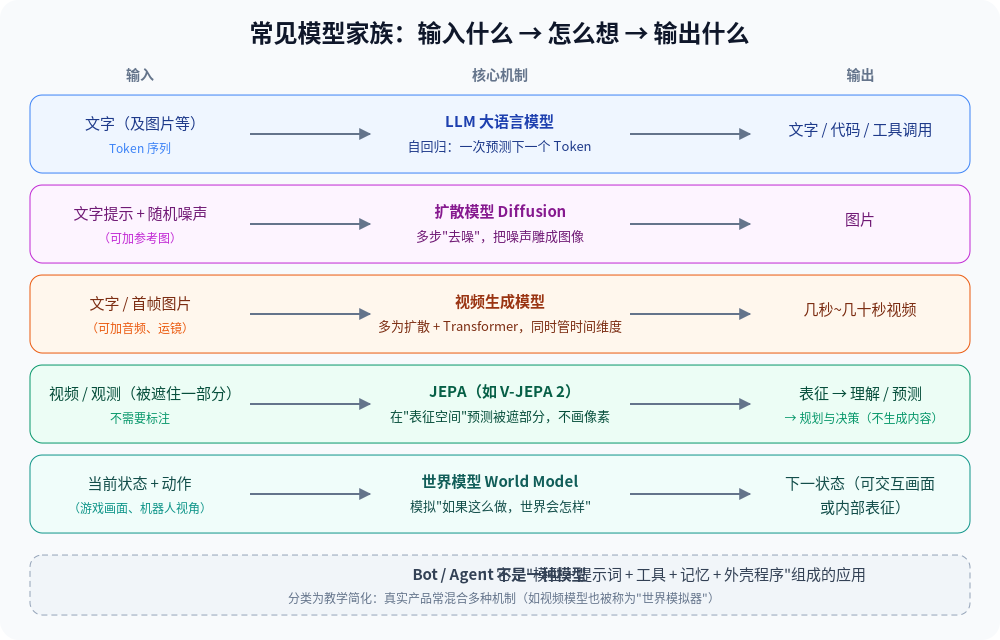
1. Master Comparison Table
| Category | Input → Output | Core Mechanism | Representative Examples | Everyday End-User Access? | Reliability Tier |
|---|---|---|---|---|---|
| LLM | Text (plus images/audio in multimodal models) → Text | Transformer autoregressively predicting the next token | GPT, Claude, DeepSeek, Qwen, GLM | ✅ Daily use | Verified |
| Diffusion Model | Text prompt + noise → Image | Iterative multi-step denoising | Stable Diffusion, FLUX, etc. | ✅ Text-to-image | Verified (DDPM, arXiv:2006.11239) |
| Video Generation Model | Text / image → Video | Typically Diffusion + Transformer with temporal consistency | Sora, Veo, Kling, etc. | ✅ | Verified (products available) |
| JEPA | Observations (image/video) → Representations & predictions (does not output pixels) | Predicts masked/future targets in representation space | I-JEPA, V-JEPA 2 | ⚠️ Research / developer focus | Verified |
| World Model | Current state + action → Next state | Learns how an environment evolves over time | Genie 3, V-JEPA 2-AC, etc. | ⚠️ Limited previews | Verified / Definition debated |
| Decision / Policy Model | State → Action | Reinforcement learning or sequence modeling | AlphaGo family, Decision Transformer, VLA | ⚠️ Games / robotics | Verified |
| Bot / Agent | User request → Completed task | Application layer: Model + prompts + tools + memory | Support bots, Codex, OpenClaw | ✅ | Community Consensus |
2. LLMs: Autoregressive Text Generators
For the underlying mechanics, see How Large Language Models Work: Tokens, Context, Generation, and Hallucinations. The key takeaway: an LLM's universe is a sequence of tokens, and all of its capabilities (coding, reasoning, writing, tool use) are expressed by emitting text tokens.
3. Diffusion Models: Sculpting Images Out of Noise

- [Verified] Latent Diffusion models such as the Stable Diffusion family (arXiv:2112.10752) perform iterative denoising inside a compressed latent space before decoding back to RGB pixels via a VAE — which is why a ComfyUI node graph flows from
KSampler → VAE Decode(see ComfyUI Getting Started: Installation, Nodes, Model Files, and Your First Image). - [Community Consensus] Some image generators use autoregressive or hybrid approaches instead; equating all text-to-image generation with diffusion is a common shorthand rather than an absolute rule.
4. Video Models: Diffusion Across Time
- Builds on image generation by adding a temporal dimension: characters, objects, and lighting must remain coherent across frames.
- [Verified] OpenAI's Sora technical report framed large video generation models as an early exploration toward "world simulators": Video generation models as world simulators.
- [Community Consensus] However, rendering visually plausible video frames is not the same as understanding rigid-body physics — clipping, morphing, and objects materializing out of nowhere remain common failure modes.
5. JEPA ("jev") and Decision-Oriented Architectures
5.1 What JEPA Is and How It Works
[Verified]
- In his 2022 position paper A Path Towards Autonomous Machine Intelligence, Yann LeCun proposed JEPA, arguing that intelligent systems should learn world models that predict inside an abstract representation space rather than attempting to reconstruct every pixel or token.
- Key milestones include I-JEPA for images (arXiv:2301.08243) and V-JEPA 2 for video (arXiv:2506.09985, Meta AI Blog).
- V-JEPA 2 (~1.2B parameters) is pre-trained via self-supervised learning on over 1 million hours of internet video; using under 62 hours of robot trajectory data, Meta trained an action-conditioned variant (V-JEPA 2-AC) capable of zero-shot robotic pick-and-place planning from goal images in unseen environments. In 2026, V-JEPA 2.1 followed (arXiv:2603.14482).
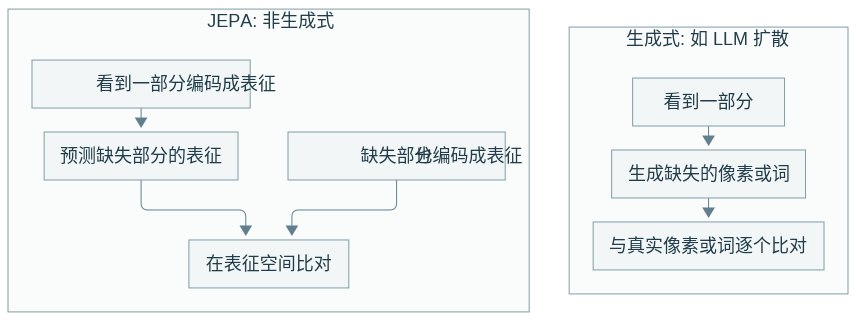
In plain terms: A generative video model is forced to predict the exact texture of every fluttering leaf on a tree; JEPA only needs to represent "there is a tree swaying in the wind." By discarding unpredictable pixel-level noise and focusing on predictable structure, it aligns naturally with downstream understanding, prediction, and planning. [Community Consensus / Research Summary]
What it does not do: JEPA itself does not generate images, videos, or essays, so consumers do not chat with a JEPA model directly. Its primary impact is in robotics, physical planning, and video representation learning.
5.2 Distinguishing JEPA from Other Decision-Oriented Models
| Type | Input → Output | Training Paradigm | Examples | How It Differs from JEPA | Reliability Tier |
|---|---|---|---|---|---|
| RL Policy Model | State → Action | Trial-and-error + reward signal | AlphaGo / AlphaZero (Nature 2016) | Directly learns "what action to take"; JEPA learns "how the world state evolves" so a planner can choose actions | Verified |
| Decision Transformer | (Target return, state, past actions) → Next action | Casts control as offline sequence modeling | arXiv:2106.01345 | Autoregressively predicts action tokens rather than predicting future world embeddings | Verified |
| VLA (Vision-Language-Action) | Image + language instruction → Robot action | Adds action heads/tokens to a VLM and trains on robot demonstrations | RT-2 (arXiv:2307.15818), OpenVLA (arXiv:2406.09246) | Outputs actions end-to-end by leveraging VLM semantic priors; the JEPA route prioritizes learning predictive world representations first | Verified |
| World Model + Planner | State + candidate actions → Predicted outcome → Best action | Learns environment dynamics | V-JEPA 2-AC, Dreamer family | V-JEPA 2-AC belongs directly to this paradigm | Verified |

📌 On the phrase "pure decision model": Strictly speaking, JEPA learns representations and state predictions while a planning module on top selects the action; models that directly emit actions from states are policy networks or VLAs. Calling JEPA a "decision model" is a loose shorthand for its downstream use case in planning and control. [Editorial Interpretation, Pending Confirmation]
6. "World Models": One of the Most Overloaded Terms in AI
[Community Consensus] The term "world model" is currently used in at least three distinct ways:
| Usage | Examples | Interactive? |
|---|---|---|
| Environment dynamics models in robotics and reinforcement learning | V-JEPA 2-AC, Dreamer | Used internally by the planner |
| Interactive generative virtual environments | Google DeepMind Genie 3 (Official Blog) | ✅ Real-time user/agent control |
| Marketing shorthand claiming a video generator "understands physical laws" | Promotional copy for various text-to-video tools | ❌ |
7. Bots and Agents: Assembled Applications, Not Model Architectures
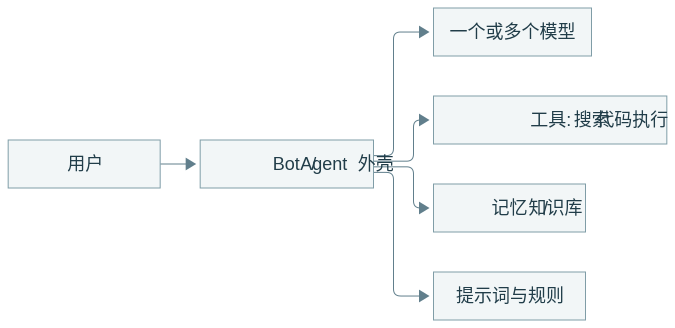
The exact same foundation model can power a customer-service bot, an autonomous coding agent, or a roleplay character in SillyTavern (SillyTavern Illustrated Guide: Connections, Character Cards, World Info, and Prompts) — the difference lies in the application harness, not the underlying model family.
8. Other Essential Model Categories You Will Encounter
| Category | What It Does | Examples | Reliability Tier |
|---|---|---|---|
| Embedding Models | Text / images → dense vectors for retrieval and clustering | Commercial and open-weight embedding APIs | Verified |
| Rerankers | Re-scores candidate search results for higher relevance | Standard second stage in RAG pipelines | Community Consensus |
| Speech Recognition (ASR) | Audio speech → transcribed text | Whisper (arXiv:2212.04356) | Verified |
| Speech Synthesis (TTS) / Music Generation | Text → spoken audio or music | Commercial and local TTS engines | Community Consensus |
| Vision Classification / Detection / Segmentation | Image → class labels, bounding boxes, or pixel masks | YOLO, SAM series | Community Consensus |
| Contrastive Vision-Language Models | Aligns images and text in a shared embedding space | CLIP (arXiv:2103.00020), widely used in diffusion text conditioning | Verified |
| Scientific Foundation Models | Protein folding, weather forecasting, materials discovery | AlphaFold (Nature 2021) | Verified |
| Recommendation & Ranking Models | Determines feed ranking and content personalization | Major content and commerce platforms | Community Consensus |
| Time-Series Forecasting | Demand, load, and financial series prediction | Domain-specific forecasting models | Community Consensus |
| Safety Classifiers / Guardrails | Flags risky content or dangerous shell actions | Auto-approval classifiers in coding agents (Claude Code Guide: Installation, Permissions, and Project Workflows / Qoder Guide: IDE, CLI, Permissions, and Custom Models) | Community Consensus |
Do not confuse "task category" with "network architecture": MoE (Mixture of Experts) and Mamba/SSM (arXiv:2312.00752) are architectural backbones that can be used to build an LLM; they are not a separate application category competing against LLMs. [Community Consensus]
9. Unverified Items and Practical Caveats
- Interpreting "jev" as JEPA reflects the user's note on non-generative decision/planning architectures and remains open to clarification.
- "World model" has no single industry-wide definition; always check what a specific paper or product actually takes as input and emits as output.
- Internal architectures of proprietary video generators are largely undisclosed.
- Whether representation-prediction architectures like JEPA will outperform generative paradigms on broad general intelligence remains an active, open research debate.
Hands-On Practice: Step-by-Step Verification
Goal: Classify any newly announced AI model or product by inspecting its inputs, outputs, and system layer.
Use the checklist below whenever you encounter a new AI release or research paper.
-
Locate the official model card or technical documentation first, and write down the exact input modalities it accepts and the output format it produces.
-
Label whether the core model performs text generation, image/video denoising, representation prediction, or action selection. Remember that understanding an image as input is distinct from generating an image as output.
-
Identify whether you are looking at raw model weights, a hosted inference API, or a tool-equipped application shell; Agents and Bots live at the application layer and should not be conflated with a neural architecture.
-
When evaluating a "world model" announcement, check whether it accepts real-time action inputs, supports interactive rollouts, and provides reproducible benchmarks or demos.
-
Keep empirical benchmark scores, product availability, and editorial opinions separate in your notes, and avoid extrapolating a single demo into universal capability across a whole model family.