Second-Draft Verification Note (2026-10-15): This is the second draft of the HeLuoXu tutorial, revised against official specifications and documentation. Legacy experiment logs are labeled separately as "First-Draft Retained Output" and do not represent a re-run on Windows in this pass; see the current batch verification records for the environment and results of this pass. Examples such as "StarRiver Notes", accounts, orders, prices, and policies are fictional teaching data.
One-Sentence Definition
A version control system records explicitly saved file versions and their relationships, supporting diff inspection, history tracing, and collaborative merging. It does not automatically save every keystroke; which states can be restored depends on saved objects, references, and retention policies.
Why It Matters
- Safe rollback: When prompts, configurations, or code break, you can return precisely to "the version that worked yesterday" instead of relying on files like
prompt_final_v3_really_final.txt. - Traceability: Every change records an author, timestamp, and message. When an issue arises, you can inspect the commit metadata alongside code review records to diagnose the root cause.
- Collaboration: When multiple people edit the same project concurrently, the tool attempts a text merge; even when no conflict is reported, you must still verify semantic compatibility.
- Essential for AI projects: Shifts in model quality often come from subtle edits to prompts, dataset splits, or dependency versions. Without version control, regression testing (k4.eval.regression-test) has no reliable baseline for comparison.
How It Works / Diagram
This tutorial builds a foundational mental model around three operations: storing snapshots, computing diffs, and performing merges.
| Concept | Meaning | Modern Implementation (Git) |
|---|---|---|
| Snapshot / Commit | The state of the entire file set at a point in time + author, timestamp, commit message, and parent commit(s) | Each commit records a full directory tree; unchanged files reuse existing objects |
| Content Addressing | Using the cryptographic hash of the content as the object's "address" | Git commonly uses SHA-1 and also supports SHA-256 depending on tooling |
| Diff | Line-by-line comparison between two versions | Computed on demand rather than stored as the primary format |
| Three-Way Merge | Determining who changed what by referencing the common ancestor of two branches | Uses the ort merge strategy by default |
| Centralized vs. Distributed | History stored centrally (e.g., SVN, though working copies still carry local metadata) vs. a standard full clone carrying reachable history (Git, Mercurial) | Distributed: commits and history queries run locally |
Chapter 1 of Pro Git, "About Version Control", introduces local, centralized, and distributed VCS architectures: https://git-scm.com/book/en/v2/Getting-Started-About-Version-Control; Git stores data as snapshots rather than deltas: https://git-scm.com/book/en/v2/Getting-Started-What-is-Git%3F
Why a three-way merge requires a common ancestor:
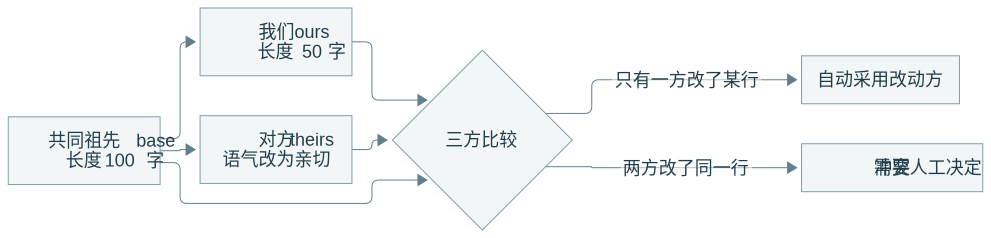
The decision rule can be summarized per line: if ours == theirs, keep it directly; if ours == base, only the other side changed it, so take theirs; if theirs == base, take ours; otherwise flag a conflict.
Applicable Boundaries & Verification Points
The revision graph reflects commit relationships, whereas author fields and messages do not equate to cryptographically authenticated identity or verified intent. Git's snapshot model is logical; packed objects still use delta compression under the hood. A standard full clone includes reachable history, but shallow clones, partial clones, and single-branch clones are exceptions. A clean text merge only means the tool detected no textual overlap—semantic conflicts still require review and testing. The example below compares matching line indices assuming three equal-length, pre-aligned inputs; furthermore, a 12-character truncated hex hash is not suitable as a unique identifier in a production object store.
Primary references verified in this pass (2026-10-15):
- Pro Git: Git's Snapshot Model: logical snapshots, local operations, and committed data.
- Official git merge Manual: automatic merging, conflicts, and merge states.
Runnable Example
This script uses the Python standard library to demonstrate content addressing, snapshots, diffs, and three-way comparison across pre-aligned lines. It is an in-memory toy model and does not invoke Git.
# File: examples/01_version_control.py
"""Implement a toy version control system in 60 lines of Python: content-addressed storage + snapshots + diff + three-way merge."""
import hashlib, difflib, json

store = {}                                  # Object store: hash -> content (same core idea as Git's .git/objects)
def put(data: bytes) -> str:
    h = hashlib.sha256(data).hexdigest()[:12]
    store[h] = data
    return h

def commit(files: dict, parent, msg):
    tree = {name: put(text.encode()) for name, text in sorted(files.items())}   # Each file content -> object
    meta = json.dumps({"tree": tree, "parent": parent, "msg": msg}, sort_keys=True).encode()
    return put(meta)

def files_of(c):
    tree = json.loads(store[c])["tree"]
    return {n: store[h].decode() for n, h in tree.items()}

print("1. Two commits (snapshots rather than diffs)")
v1 = commit({"prompt.txt": "You are StarRiver Notes support.\nKeep answers concise.\n", "README": "demo\n"}, None, "Initial version")
v2 = commit({"prompt.txt": "You are StarRiver Notes support.\nKeep answers concise.\nSay you do not know if unsure.\n", "README": "demo\n"}, v1, "Add abstention rule")
log, c = [], v2
while c:
    m = json.loads(store[c]); log.append(f"  {c}  {m['msg']}  parent={m['parent']}"); c = m["parent"]
print("\n".join(log))
t1, t2 = json.loads(store[v1])["tree"], json.loads(store[v2])["tree"]
print("  README object hash is identical across both versions (unchanged files are not stored twice):", t1["README"] == t2["README"])
print("  Total objects in object store:", len(store))

print("\n2. Diff from v1 -> v2 (unified diff)")
a, b = files_of(v1)["prompt.txt"], files_of(v2)["prompt.txt"]
print("".join(difflib.unified_diff(a.splitlines(True), b.splitlines(True), "v1/prompt.txt", "v2/prompt.txt")))

print("3. Three-way merge: use common ancestor base to tell which side modified which line")
def merge3(base, ours, theirs):
    out, conflicts = [], 0
    for i, (b, o, t) in enumerate(zip(base, ours, theirs)):
        if o == t:            out.append(o)          # Both sides agree
        elif o == b:          out.append(t)          # Only theirs changed -> take theirs
        elif t == b:          out.append(o)          # Only ours changed -> take ours
        else:                                         # Both sides changed the same line -> conflict
            conflicts += 1
            out += ["<<<<<<< ours", o, "=======", t, ">>>>>>> theirs"]
    return out, conflicts
base   = ["Tone: polite", "Length: under 100 words", "Language: Chinese"]
ours   = ["Tone: polite", "Length: under 50 words",  "Language: Chinese"]      # A edits length
theirs = ["Tone: friendly", "Length: under 100 words", "Language: Chinese"]   # B edits tone
m, k = merge3(base, ours, theirs); print("  Edits on different lines -> conflicts:", k, "->", m)
theirs2 = ["Tone: polite", "Length: under 80 words", "Language: Chinese"]     # B also edits length
m, k = merge3(base, ours, theirs2); print("  Edits on the same line   -> conflicts:", k); print("\n".join("    " + x for x in m))

print("\n4. Why a two-way merge (without base) is insufficient: looking only at ours and theirs cannot tell who made the change")
print("  ours line 1 =", ours[0], " theirs line 1 =", theirs[0], " -> cannot tell which one to pick, must report conflict")
First-Draft Retained Output
The following log is retained from the first draft and reflects the original environment claimed there; it is not the re-run output of this pass. Second-draft code edits may produce different output; refer to the current batch verification records for the actual re-run status.
1. Two commits (snapshots rather than diffs)
  abef9633776a  Add abstention rule  parent=568d179b6d01
  568d179b6d01  Initial version  parent=None
  README object hash is identical across both versions (unchanged files are not stored twice): True
  Total objects in object store: 5

2. Diff from v1 -> v2 (unified diff)
--- v1/prompt.txt
+++ v2/prompt.txt
@@ -1,2 +1,3 @@
 You are StarRiver Notes support.
 Keep answers concise.
+Say you do not know if unsure.

3. Three-way merge: use common ancestor base to tell which side modified which line
  Edits on different lines -> conflicts: 0 -> ['Tone: friendly', 'Length: under 50 words', 'Language: Chinese']
  Edits on the same line   -> conflicts: 1
    Tone: polite
    <<<<<<< ours
    Length: under 50 words
    =======
    Length: under 80 words
    >>>>>>> theirs
    Language: Chinese

4. Why a two-way merge (without base) is insufficient: looking only at ours and theirs cannot tell who made the change
  ours line 1 = Tone: polite  theirs line 1 = Tone: friendly  -> cannot tell which one to pick, must report conflict
- 1. The two commits produce 5 objects in total: 2 file-content blobs + 1 commit metadata object in
v1, whilev2adds only the modifiedprompt.txtblob and 1 new commit metadata object. BecauseREADMEdid not change, both commits point to the exact same object hash (outputtingTrue). That is how snapshot storage avoids wasting space. - 2. The diff is computed on the fly from two snapshots;
+Say you do not know if unsure.indicates an added line. - 3. When A edits the length line and B edits the tone line, the three-way merge automatically resolves to
['Tone: friendly', 'Length: under 50 words', 'Language: Chinese']because the edits touch different lines. When both edit the "Length" line, the conflict count is 1 and Git-style<<<<<<</=======/>>>>>>>conflict markers are emitted. - 4. Without a common ancestor, there is no way to tell whether "polite" or "friendly" is the newer value—that is why a three-way merge normally requires a common ancestor, while special cases such as unrelated histories must be handled separately.
- Note: Real-world merge tools align lines using algorithms such as Longest Common Subsequence (LCS) to handle insertions and deletions; for simplicity, this toy script compares lines strictly by index.
Self-Test
Question: Two developers modify different files and Git merges them automatically without conflict. Can you conclude that the resulting program is compatible?
Reference Answer: No. One change might alter a function signature or behavior while the other relies on the old contract in a caller; a clean text merge does not validate runtime behavior. You should check interface contracts and run the relevant test suite.
Common Misconceptions
- "Version control is just backup": Backups only store copies; version control also records causal lineage (parent commits), commit messages, and authors, while supporting branch merges.
- "A VCS stores only the diffs between versions": Git stores logical snapshots and computes diffs on demand (see the Pro Git links above), though some earlier systems (such as RCS) did store deltas.
- "Only source code needs version control": Prompts, evaluation datasets, configurations, and documentation should all be versioned; large binary artifacts (model weights, large datasets) are better suited to tools like Git LFS or DVC.
- "A merge conflict means the merge tool is broken": A conflict means the tool refuses to guess on your behalf—when two people edit the same region, a human must decide.
Connection to AI Development
- Store prompts and evaluation sets in the same repository and commit as your application code so every shift in model quality traces back to a concrete change.
- Before asking an AI coding assistant to refactor code, commit a clean baseline first. Rolling back with version control if the edit goes wrong is far more reliable than asking the model to "undo it".
- When resolving merge conflicts, the three-way context (
base,ours,theirs) is the clearest input you can give an AI assistant to explain and reconcile the conflict.
Further Reading
- Pro Git Book: https://git-scm.com/book/zh/v2
- DVC (Data and Model Version Control): https://dvc.org/doc
- Git LFS: https://git-lfs.com/
Unverified Scope
- The toy merge implementation does not align insertions, deletions, or file renames, nor does it detect semantic conflicts; it should not be used to evaluate the correctness of production VCS tools.
Current Example Execution Scope
2026-10-15: Passed. Toy snapshot / diff / line-index merge model; not a compatibility test of a production VCS.
"First-Draft Retained Output" preserves the original text and is not newly generated by the second-draft code; its original conclusions must be read together with the second-draft revisions and boundary notes.
Companion Code & Verification Materials