One-Sentence Definition
DFS explores as far as possible along a single path using recursion or an explicit stack before backtracking to explore other branches. Standard graph traversal visits every vertex and edge once, running in O(V+E) time with an adjacency list.
Why It Matters
- Forms the foundation for core graph problems such as cycle detection, topological sorting, connected components, and island counting.
- Backtracking: generating permutations, combinations, Sudoku solutions, and N-Queens placements is essentially running DFS over a decision tree.
- Pre-order, in-order, and post-order tree traversals are all forms of DFS (see k2.ds.tree).
Operating Boundaries
Backtracking tasks such as enumerating all permutations perform DFS over a much larger decision tree, so the linear time bound of basic graph traversal no longer applies. Moreover, three-color cycle detection for directed graphs differs from the parent-edge exclusion rule used in undirected graphs.
How It Works / Diagram
Example graph: A→B, A→C, B→D, C→D, C→E, D→F.
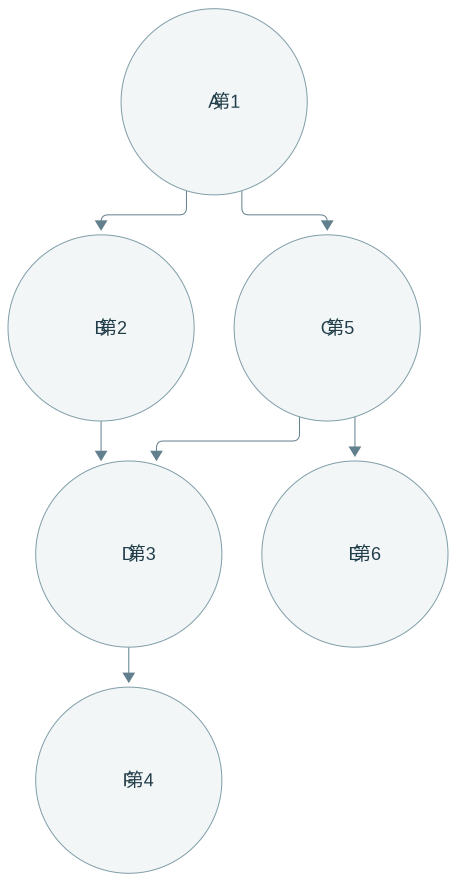
Visitation order: A → B → D → F (bottoms out) → backtracks to A → C → E (D is already visited and skipped).
Three-color cycle detection (directed graphs): White = unvisited, Gray = currently visiting (on the active recursion path), Black = completed. Encountering a Gray vertex during DFS means an edge points back to the current active path, confirming a directed cycle.
| BFS | DFS | |
|---|---|---|
| Data Structure | Queue | Stack / Recursion |
| Traversal Order | Level by level | Plunge down one path first |
| Unweighted Shortest Path | Guaranteed | Not guaranteed |
| Memory Usage | Large on wide graphs | Large on deep graphs (deep recursion) |
| Typical Use Cases | Shortest path, level-order expansion | Cycle detection, topological sort, backtracking, connectivity |
Runnable Example
Recursive and explicit-stack DFS, three-color cycle detection, grid island counting, and backtracking permutation generation (verified run log on Python 3.15.0):
# File: examples/23_dfs.py
# Depth-First Search (DFS): plunge down one path before backtracking (recursion / stack). Used for connectivity, cycle detection, and backtracking search.
import sys
sys.setrecursionlimit(10_000)

graph = {"A": ["B", "C"], "B": ["D"], "C": ["D", "E"], "D": ["F"], "E": [], "F": []}
order = []
def dfs(u, seen=None):
    seen = seen if seen is not None else set()
    seen.add(u); order.append(u)
    for v in graph[u]:
        if v not in seen: dfs(v, seen)
dfs("A"); print("Recursive DFS visit order:", order)

def dfs_iter(start):
    seen, stack, out = set(), [start], []
    while stack:
        u = stack.pop()
        if u in seen: continue
        seen.add(u); out.append(u)
        stack.extend(reversed(graph[u]))      # Push in reverse order to match recursive traversal order
    return out
print("Explicit-stack DFS visit order:", dfs_iter("A"))

# Directed graph cycle detection (three-color marking): is there a circular dependency?
def has_cycle(g):
    WHITE, GRAY, BLACK = 0, 1, 2
    color = {u: WHITE for u in g}
    def visit(u):
        color[u] = GRAY
        for v in g[u]:
            if color[v] == GRAY or (color[v] == WHITE and visit(v)): return True
        color[u] = BLACK; return False
    return any(color[u] == WHITE and visit(u) for u in g)
print("graph has cycle:", has_cycle(graph), "| after adding F->A has cycle:", has_cycle({**graph, "F": ["A"]}))

# Number of islands (connected components)
sea = ["11000", "11010", "00100", "00011"]
seen = set()
def flood(r, c):
    if not (0 <= r < len(sea) and 0 <= c < len(sea[0])) or sea[r][c] == "0" or (r, c) in seen: return
    seen.add((r, c)); [flood(r+dr, c+dc) for dr, dc in ((1,0),(-1,0),(0,1),(0,-1))]
islands = 0
for r in range(len(sea)):
    for c in range(len(sea[0])):
        if sea[r][c] == "1" and (r, c) not in seen: flood(r, c); islands += 1
print("Number of islands:", islands)

# Backtracking: full permutations (classic DFS application)
def permutations(items, path=()):
    if not items: yield path; return
    for i, x in enumerate(items): yield from permutations(items[:i] + items[i+1:], path + (x,))
print("Permutations of abc:", ["".join(p) for p in permutations("abc")])
Recorded output:
Recursive DFS visit order: ['A', 'B', 'D', 'F', 'C', 'E']
Explicit-stack DFS visit order: ['A', 'B', 'D', 'F', 'C', 'E']
graph has cycle: False | after adding F->A has cycle: True
Number of islands: 4
Permutations of abc: ['abc', 'acb', 'bac', 'bca', 'cab', 'cba']
Both implementations produce the exact same visitation sequence (the explicit-stack version pushes neighbors in reverse order); adding the edge F→A causes the three-color check to detect a cycle.
Common Pitfalls
- Using recursion on deep graphs: long node chains trigger
RecursionError(see k2.ds.stack); switch to an explicit stack instead. - Forgetting to undo choices during backtracking: state mutations must be reverted when returning from a recursive call, otherwise branches pollute each other.
- Applying three-color cycle detection to undirected graphs: in an undirected graph, the immediate parent vertex will be misidentified as a cycle unless you exclude the incoming parent edge or use Union-Find.
- Assuming DFS finds the shortest path: the first path found by DFS is not guaranteed to be the shortest.
Connection to AI Development
- Topological ordering of computation graphs: backpropagation traverses computation graphs in reverse topological order, commonly computed via post-order DFS (see k2.ds.graph).
- Recursive processing of code and documents: traversing ASTs, directory trees, and nested JSON payloads.
- Search-based reasoning: Tree of Thoughts explores reasoning branches using either BFS or DFS strategies. https://arxiv.org/abs/2305.10601
- Constraint solving and planning: backtracking with pruning is a foundational solver technique for agent planning and scheduling tasks.
Further Reading
- Wikipedia: Depth-first search https://en.wikipedia.org/wiki/Depth-first_search
- VisuAlgo Graph Traversal: https://visualgo.net/en/dfsbfs
- Introduction to Algorithms (CLRS), Chapter 22: "Elementary Graph Algorithms".
Concept Check
When using DFS to enumerate all permutations of n elements, is the time complexity still O(n)?
Reference answer: No. Generating the full output produces n! permutations, and each permutation requires recording n elements.
Verification & Reproduction
Verification date: 2026-10-14. Example status: passed. Run log for this batch: 23_dfs.py.
Companion Code & Verification Materials