One-Line Definition
Mutability describes whether an object's contents can be altered in place after creation; hashability describes whether an object has a stable hash value suitable for dictionary keys and set members. The two concepts are closely related but not identical—nested containers and custom equality rules both matter.
Why It Matters
- Determines what can be used as a
dictkey orsetelement: Only hashable objects (which are almost always immutable by value) are allowed. - Governs whether sharing references is safe: Objects whose reachable state never mutates can be passed across functions and threads without defensive copying; shared mutable objects require discipline.
- Explains one of Python's most notorious gotchas—mutable default arguments.
Usage Boundaries
User-defined mutable class instances are hashable by object identity by default, whereas an immutable tuple becomes unhashable if any element inside it is unhashable. frozendict became a built-in type in Python 3.15 and does not recursively freeze mutable values stored inside it.
How It Works / Diagram
| Type | Mutable? | Hashable? | Notes |
|---|---|---|---|
int, float, bool, str, bytes |
No | Yes | "Modifying" always allocates a new object |
tuple |
No | Only if every element is hashable | A tuple containing a list is unhashable |
frozenset |
No | Yes | Immutable set |
frozendict (new in 3.15) |
No | Only if all keys and values are hashable | Added in PEP 814 |
list, dict, set, bytearray |
Yes | No | |
| Custom class instance | Yes by default | Hashable by identity by default | @dataclass(frozen=True) blocks attribute reassignment but does not recursively freeze mutable field contents |
Python 3.15 (released 2026-10-09) introduced the built-in frozendict type: it is not a subclass of dict, preserves insertion order while comparing order-independently, and is hashable whenever all of its keys and values are hashable: https://docs.python.org/3.15/whatsnew/3.15.html#pep-814-add-frozendict-built-in-type
How the mutable default argument trap works under the hood:
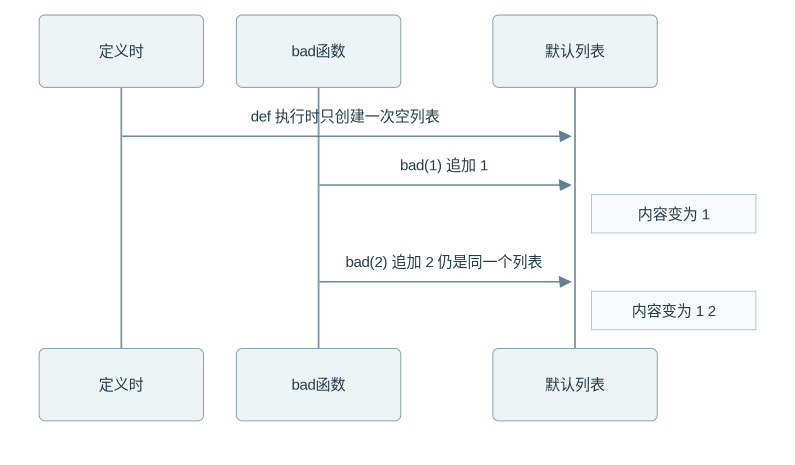
The official Python tutorial explicitly warns: "The default value is evaluated only once. This makes a difference when the default is a mutable object such as a list, dictionary, or instances of most classes": https://docs.python.org/3/tutorial/controlflow.html#default-argument-values
Runnable Example
# File: examples/19_mutability.py
# Mutable vs. immutable objects, plus the classic mutable default argument trap
import sys
print("Python", sys.version.split()[0])

s = "abc"
try:
    s[0] = "z"
except TypeError as e:
    print("str is immutable:", e)

t = (1, [2, 3])           # The tuple container is immutable, but the inner list is mutable
t[1].append(4)
print("Inner list inside tuple mutated:", t)
try:
    hash(t)
except TypeError as e:
    print("Therefore this tuple is unhashable:", e)

# Classic trap: default arguments are evaluated once at function definition time
def bad(item, bucket=[]):
    bucket.append(item); return bucket
def good(item, bucket=None):
    bucket = [] if bucket is None else bucket
    bucket.append(item); return bucket
print("bad :", bad(1), bad(2))
print("good:", good(1), good(2))

# Benefit of immutability: usable as a dictionary key and safe to share
cache = {(3, 4): 5.0}
print("Tuple as dict key:", cache[(3, 4)])

# Python 3.15 built-in frozendict (PEP 814): immutable, hashable mapping
if sys.version_info >= (3, 15):
    fd = frozendict(model="deepseek", temperature=0.2)
    print("frozendict:", fd, "| hashable:", hash(fd) == hash(frozendict(temperature=0.2, model="deepseek")))
    try:
        fd["model"] = "x"
    except TypeError as e:
        print("frozendict cannot be mutated:", e)
Recorded output (Python 3.15.0):
Python 3.15.0
str is immutable: 'str' object does not support item assignment
Inner list inside tuple mutated: (1, [2, 3, 4])
Therefore this tuple is unhashable: unhashable type: 'list'
bad : [1, 2] [1, 2]
good: [1] [2]
Tuple as dict key: 5.0
frozendict: frozendict({'model': 'deepseek', 'temperature': 0.2}) | hashable: True
frozendict cannot be mutated: 'frozendict' object does not support item assignment
Notice bad : [1, 2] [1, 2]: both calls mutate and return the exact same underlying list object, so by the time print evaluates both return values, both references show [1, 2].
Common Misconceptions
- "A tuple is immutable, so nothing inside a tuple can ever change": A tuple only guarantees that the tuple slots keep pointing to the same object identities; if one slot holds a
list, that list can still be mutated in place. - Thinking
s += "x"mutates a string in place: Strings are immutable, so concatenation allocates a new string and rebinds the variable name. Use"".join(...)when accumulating many fragments in a loop. - Using a mutable literal as a function default: Always default to
Noneand create a fresh container inside the function body. Ruff'sB006lint rule flags this automatically: https://docs.astral.sh/ruff/rules/mutable-argument-default/ - Assuming
@dataclass(frozen=True)performs a deep freeze: Just like a tuple, if a frozen dataclass has alistattribute, elements can still be appended to that list.
Connection to AI Development
- Memoization requires hashable cache keys: Decorators like
functools.cacherequire every argument to be hashable. Wrapping generation parameters in afrozendictortuplelets you cache LLM responses by configuration cleanly. - Pandas 3.0 Copy-on-Write: Shifts DataFrame slicing semantics away from error-prone in-place mutation rules so derived views behave like independent copies, preventing accidental mutation of upstream training tables (see k1.lib.pandas).
- Multi-threading and free-threaded Python: When running without the GIL, concurrent mutation of shared dictionaries or lists causes data races directly; immutable data structures eliminate shared-mutation hazards across worker threads (see k1.py.threading).
Further Reading
- Python Data Model (Mutability and Hashability): https://docs.python.org/3/reference/datamodel.html
- Python Glossary — hashable: https://docs.python.org/3/glossary.html#term-hashable
- PEP 814 — Add
frozendictbuilt-in type: https://peps.python.org/pep-0814/
Comprehension Check
Why does Python raise a TypeError if you try to use a tuple containing a list as a dictionary key?
Reference answer: A tuple's hash value is computed from the hashes of all of its elements; because a mutable list is unhashable, the enclosing tuple cannot be hashed either.
Verification & Reproduction
Verified on: 2026-10-14. Example status: Passed (verified on Python < 3.15 with the frozendict guard branch skipped, and recorded on Python 3.15.0). Run log: 19_mutability.py.
Companion Code & Verification Materials