One-Sentence Definition
A programming paradigm is an approach to structuring programs: imperative style specifies step-by-step execution, whereas declarative style specifies the target result or relationships; functional, object-oriented, and other paradigms can be combined within the same program.
Why It Matters
- The exact same problem looks completely different across paradigms. Recognizing paradigms helps you understand why Pandas method chaining, SQL queries, React components, and PyTorch's
nn.Moduleeach feel distinct. - Choosing the right structure reduces hidden state and duplicated logic: stateful domain workflows fit naturally into objects (OOP), data transformation pipelines suit functional composition, and data retrieval fits declarative queries.
- It gives you precise vocabulary when directing AI coding tools. Asking an AI assistant to "refactor this into a pure function" or "convert this into declarative configuration" steers code generation cleanly.
Practical Boundaries
Look at where change happens before picking a paradigm: encapsulate complex mutable state inside objects, express data transformations as pure functions, and hand querying over to declarative interfaces. The taxonomy below is an introductory mental model rather than a mutually exclusive or exhaustive formal classification.
How It Works / Diagram
There are many ways to classify paradigms, most commonly starting with two broad branches:
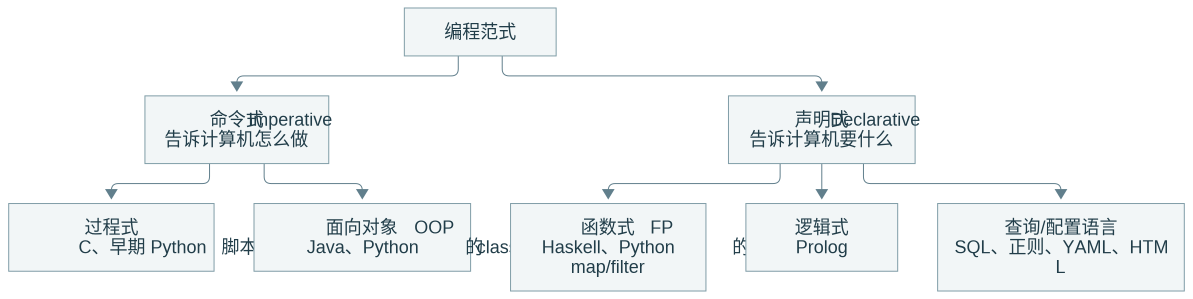
| Paradigm | Building Blocks | Primary Focus | Typical Examples |
|---|---|---|---|
| Imperative / Procedural | Statements, variable assignments, loops | How state changes at every step | C, Shell scripts |
| Object-Oriented (OOP) | Objects (data + methods) | Which object owns which responsibility | Java, C#, Python |
| Functional (FP) | Pure functions, immutable data | How inputs map to outputs | Haskell, Clojure, Elixir |
| Declarative (broad) | Rules, queries, desired target state | What the final result should look like | SQL, HTML, Terraform |
Python officially describes itself as a multi-paradigm language: the opening section of its Functional Programming HOWTO groups languages into procedural, declarative, object-oriented, and functional styles, noting that Python supports multiple paradigms. Source: https://docs.python.org/3/howto/functional.html
Paradigms are not mutually exclusive silos—they are design tendencies. Almost all mainstream modern languages (Python, JavaScript, Kotlin, Rust) are multi-paradigm, and practical software often uses "objects as the skeleton, pure functions as the muscle, and declarative files for configuration."
Runnable Example
Here is the exact same task—computing the sum of squares of even numbers from 1 to 10—written in four different styles (verified on Python 3.15.0):
# File: examples/01_paradigm.py
# Same task: sum of squares of even numbers in 1..10 across paradigms
nums = range(1, 11)

# 1) Imperative: tell the computer step by step "how to do it"
total = 0
for n in nums:
    if n % 2 == 0:
        total += n * n
print("Imperative:", total)

# 2) Functional: compose data transformations with pure functions
from functools import reduce
print("Functional:", reduce(lambda acc, x: acc + x,
                        map(lambda n: n * n, filter(lambda n: n % 2 == 0, nums)), 0))

# 3) Object-Oriented: encapsulate data and behavior together
class EvenSquareSummer:
    def __init__(self, data):
        self.data = list(data)
    def evens(self):
        return [n for n in self.data if n % 2 == 0]
    def total(self):
        return sum(n * n for n in self.evens())
print("Object-Oriented:", EvenSquareSummer(nums).total())

# 4) Declarative (SQL): only describe "what result is wanted"
import sqlite3
con = sqlite3.connect(":memory:")
con.execute("CREATE TABLE t(n INTEGER)")
con.executemany("INSERT INTO t VALUES (?)", [(n,) for n in nums])
print("Declarative SQL:", con.execute("SELECT SUM(n*n) FROM t WHERE n % 2 = 0").fetchone()[0])
Captured output:
Imperative: 220
Functional: 220
Object-Oriented: 220
Declarative SQL: 220
Key observations:
- The imperative version mutates an accumulator variable
totalin place, requiring the reader to mentally step through the loop. - The functional version avoids mutable state, though deeply nested
lambdacalls hurt readability—idiomatic Python prefers a generator expressionsum(n*n for n in nums if n % 2 == 0), which blends functional and declarative clarity. - The OOP version is overkill for a one-line sum, but once requirements grow (caching, pluggable filtering policies), classes provide natural extension points.
- The SQL version writes zero loops; the database engine decides how to scan and aggregate the rows.
Common Pitfalls
- "Functional programming is superior to OOP": Neither is inherently superior; each fits different problems. Functional code excels at stateless data pipelines, while OOP excels at managing long-lived stateful resources (connections, sessions, devices).
- "Python is strictly an object-oriented language": Python supports OOP, but many well-designed Python modules rely solely on functions and standard data structures without defining a single class.
- "A project must stick to one paradigm": In a typical Django app, models are OOP classes, queries use a declarative ORM, and view handlers are often procedural functions—all coexisting cleanly.
- Sacrificing readability for paradigm purity: Forcing a straightforward loop into a three-level nested
reducemakes maintenance harder, not cleaner.
Connection to AI Development
- PyTorch vs. JAX API design offers a clear contrast: PyTorch's
nn.Moduleleans object-oriented (models are stateful objects holding parameters), whereas JAX is strictly functional (parameters are passed explicitly into pure functions transformed byjitandgrad). See JAX's official note on pure functions: https://docs.jax.dev/en/latest/notebooks/Common_Gotchas_in_JAX.html - Prompt and Agent orchestration frequently uses declarative graphs: defining nodes, edges, and tools in YAML or JSON for an execution runtime to interpret is a classic declarative pattern.
- Naming the target paradigm in prompts (e.g., "rewrite this as a pure function without mutating the input list") makes your architectural constraints explicit to coding agents.
Further Reading
- Python Official Functional Programming HOWTO: https://docs.python.org/3/howto/functional.html
- Peter Van Roy, Programming Paradigms for Dummies: What Every Programmer Should Know (2009, includes the classic paradigm taxonomy chart): https://webperso.info.ucl.ac.be/~pvr/VanRoyChapter.pdf
- Wikipedia — Programming paradigm: https://en.wikipedia.org/wiki/Programming_paradigm
Concept Check
If a method inside a class uses a list comprehension internally, which paradigm does it belong to?
Reference answer: It combines object-oriented organization with a functional/declarative data transformation—there is no need to force an entire program under a single label.
Verification & Reproduction
Verified on: 2026-10-14. Example status: Passed. Run log: 01_paradigm.py.
Companion Code & Verification Materials