One-Sentence Definition
Object-oriented programming organizes data and behavior into objects, managing state through encapsulation, interfaces, and collaboration while allowing different implementations to honor the same behavioral contract.
Why It Matters
- Managing complex state: A database connection, a chat session, or a neural network layer each carries "its own state + its own operations," making objects a natural representation.
- The backbone of mainstream frameworks: Django Models, PyTorch's
nn.Module, and scikit-learn'sfit/predictestimators are all built around OOP conventions. - Foundation for Design Patterns and SOLID: Understanding OOP is a prerequisite for k1.prog.design-patterns and k1.prog.solid.
Practical Boundaries
Inheritance expresses "is-a / can substitute for," whereas composition expresses "has-a / delegates to a component." Duck typing does not require explicit inheritance, and true substitutability depends on exception semantics, return contracts, and state invariants—not just matching method names.
How It Works / Diagram
The four pillars of OOP:
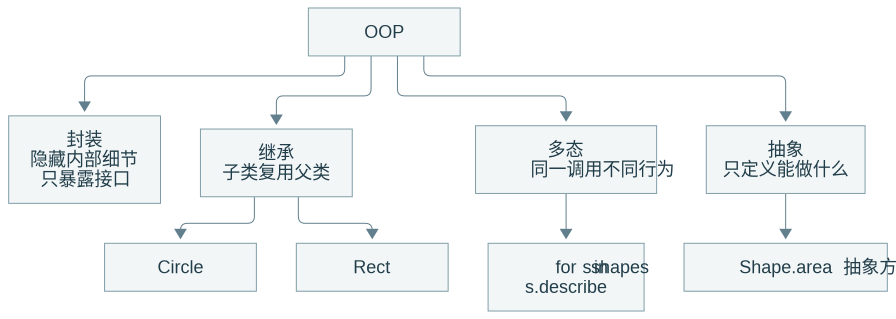
Python's approach to OOP has several distinctive traits:
| Trait | Explanation |
|---|---|
| Everything is an object | Integers, functions, and classes themselves are runtime objects (see k1.py.object-reference) |
| Encapsulation by convention | No strict keyword-enforced private; a single leading underscore _x signals "internal use," while double underscores __x trigger name mangling |
| Duck typing | "If it walks like a duck, it's a duck"—no explicit interface inheritance required; pair with typing.Protocol for static type checking |
| Abstract Base Classes | abc.ABC + @abstractmethod prevent incomplete subclasses from being instantiated |
Python Official Tutorial — Classes: https://docs.python.org/3/tutorial/classes.html ; abc module documentation: https://docs.python.org/3/library/abc.html
Runnable Example
# File: examples/05_oop.py
# Four pillars of OOP: Encapsulation, Inheritance, Polymorphism, Abstraction
from abc import ABC, abstractmethod

class Shape(ABC):                      # Abstraction: defines "what it can do"
    @abstractmethod
    def area(self) -> float: ...
    def describe(self):
        return f"{type(self).__name__} area={self.area():.2f}"

class Circle(Shape):                   # Inheritance
    def __init__(self, r): self._r = r # Encapsulation: leading underscore marks internal attribute
    def area(self): return 3.14159 * self._r ** 2

class Rect(Shape):
    def __init__(self, w, h): self.w, self.h = w, h
    def area(self): return self.w * self.h

for s in [Circle(1), Rect(2, 3)]:      # Polymorphism: same call, type-specific behavior
    print(s.describe())

try:
    Shape()
except TypeError as e:
    print("Abstract class cannot be instantiated:", e)

# Composition over inheritance: a Car "has an" Engine rather than "is an" Engine
class Engine:
    def start(self): return "Engine started"
class Car:
    def __init__(self): self.engine = Engine()
    def drive(self): return self.engine.start() + " -> Rolling"
print(Car().drive())
Captured output (Python 3.15.0):
Circle area=3.14
Rect area=6.00
Abstract class cannot be instantiated: Can't instantiate abstract class Shape without an implementation for abstract method 'area'
Engine started -> Rolling
Notice the third line: the abstract class Shape cannot be instantiated directly—Python raises a TypeError at object creation time if a required @abstractmethod like area is missing.
Common Pitfalls
- Deep inheritance hierarchies: Five or six levels of subclassing make it hard to trace where a method is actually defined. "Favor object composition over class inheritance" is one of the foundational principles from Design Patterns (GoF, 1994)—in the example above, a
Carhas anEnginerather than is anEngine. - Wrapping everything in a class: A class with only one method alongside
__init__and no meaningful lifecycle state should usually just be a plain function. Jack Diederich's PyCon 2012 talk Stop Writing Classes covers this anti-pattern directly: https://www.youtube.com/watch?v=o9pEzgHorH0 - Java-style getter/setter boilerplate: Python's
@propertydecorator lets you add validation later without breaking attribute access syntax, so avoid writingget_x()/set_x()upfront. - Assuming objects must mirror physical real-world nouns: Many of the most useful objects represent purely technical abstractions (iterators, context managers, retry policies) rather than physical things.
Connection to AI Development
- PyTorch models are stateful objects: In
class MyNet(nn.Module),__init__registers sub-layers (state = trainable parameters) andforwarddefines computation, whilemodel.train()/eval()toggles internal mode flags. https://docs.pytorch.org/docs/stable/generated/torch.nn.Module.html - scikit-learn's estimator interface (
fit/predict/transform) is a textbook application of polymorphism: swapping algorithms requires changing only the class constructor while downstream pipeline code stays untouched. https://scikit-learn.org/stable/developers/develop.html - LLM provider abstractions: Wrapping OpenAI, Claude, and local inference endpoints behind a unified polymorphic client interface keeps business logic decoupled from any single vendor SDK.
Further Reading
- Python Tutorial — Classes: https://docs.python.org/3/tutorial/classes.html
- Python Data Model (authoritative reference on special dunder methods): https://docs.python.org/3/reference/datamodel.html
- Luciano Ramalho, Fluent Python (2nd Edition, 2022), Chapters 11–14
Concept Check
If two LLM client classes both expose a chat method, can they be swapped directly without further checks?
Reference answer: Only after confirming that their parameter semantics, return types, exception contracts, and resource lifecycles also match; sharing a method name is only the starting point.
Verification & Reproduction
Verified on: 2026-10-14. Example status: Passed. Run log: 05_oop.py.
Companion Code & Verification Materials